
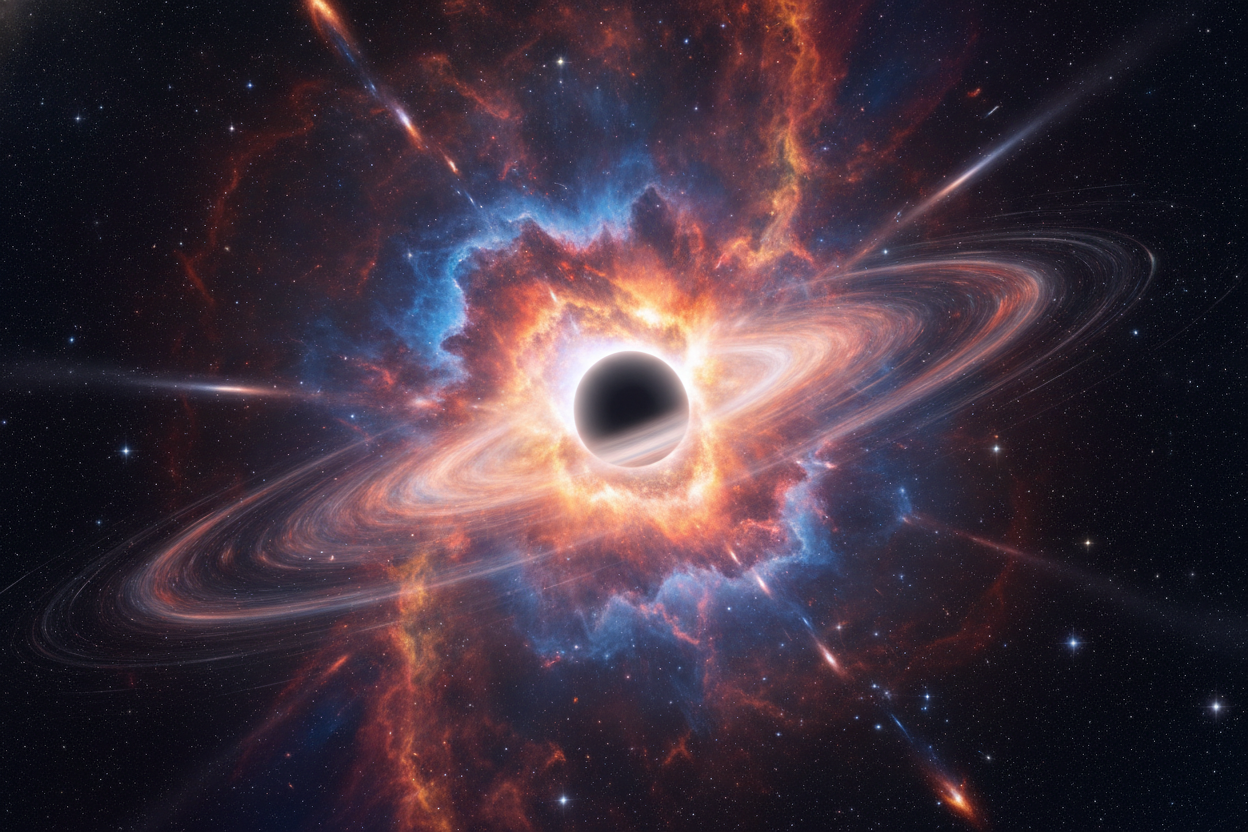
Black holes begin with stars, but not just any stars. The largest stars end their lives in dramatic supernova explosions after running out of nuclear fuel. When that fuel is gone, the outward pressure holding the star up disappears, and gravity takes over. The core collapses inward with such force that it can create a black hole, a region where gravity becomes incredibly intense.
What makes black holes so intriguing is that they are invisible in the usual sense. Scientists cannot see them directly because not even light can escape once it crosses the event horizon. Instead, researchers detect their effects by observing nearby gas, stars, and radiation. This indirect method has helped confirm that black holes are not just theoretical ideas but real objects in the universe.
Black holes also challenge our understanding of physics. They combine general relativity, which explains gravity on large scales, with quantum theory, which governs the smallest particles. Because of that, they sit at the center of some of the biggest questions in science. What happens inside them? Can information escape? How do they connect to the origins of the universe?
For science audiences, black holes are a perfect example of how curiosity leads to discovery. They are extreme, mysterious, and backed by real observation, which makes them ideal topics for educational videos that want to spark wonder while teaching solid scientific ideas.
Leave a Reply