
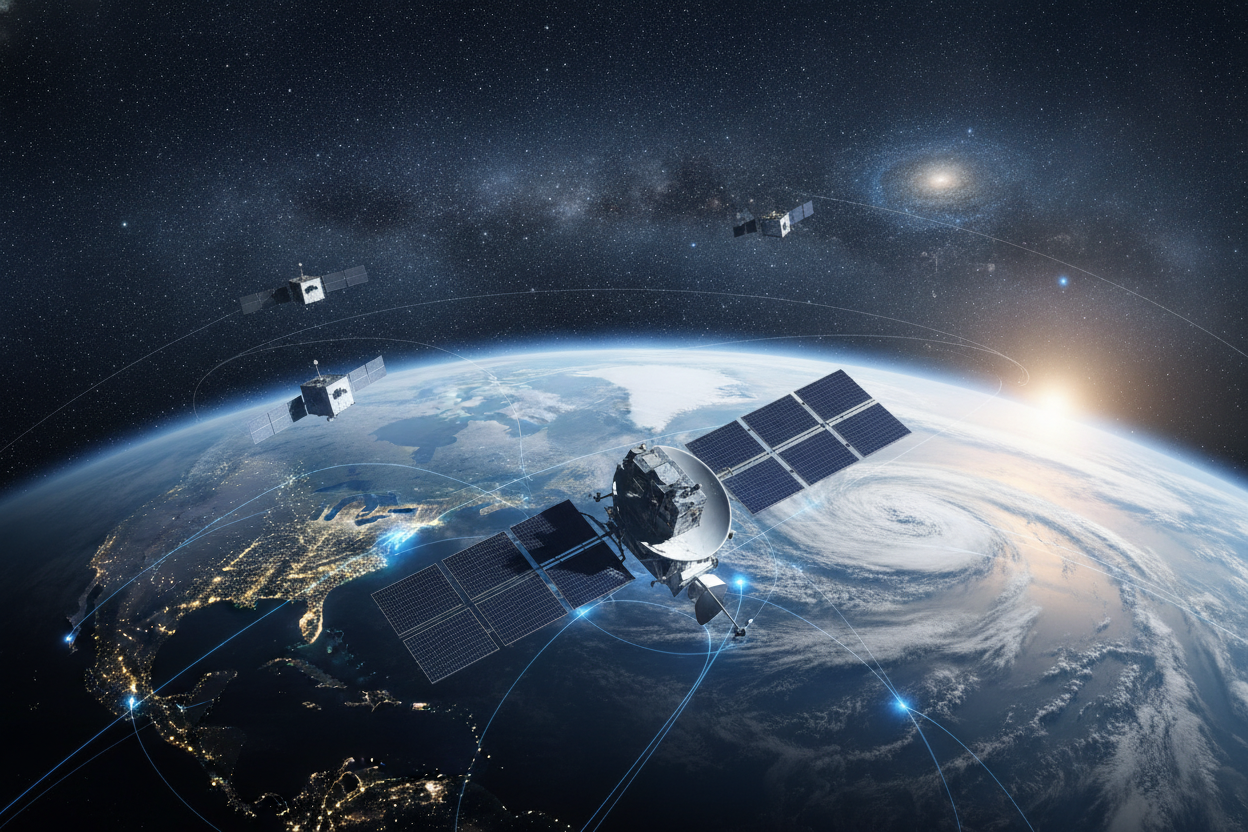
Satellites may seem distant and mysterious, but their basic function is surprisingly straightforward. A satellite is any object that orbits a larger body, and in modern life the word usually refers to machines launched into space by humans. These devices circle Earth or other celestial bodies and perform tasks that affect communication, navigation, weather prediction, and scientific research.
The reason satellites stay in orbit is a balance between motion and gravity. They move forward fast enough that, as they fall toward Earth, the planet curves away beneath them. This creates a stable path around the planet. Different satellites are placed in different orbits depending on what they need to do, whether that is providing global internet, taking images of storms, or helping a phone find a location.
Satellites have become essential to modern infrastructure. Weather satellites track clouds and temperature patterns, while communications satellites carry television, internet, and emergency signals. Earth observation satellites help monitor forests, oceans, and changes in the climate. Without them, many systems people rely on every day would be slower, less accurate, or far less connected.
For science learners, satellites are a great example of applied physics. They show how orbital mechanics, engineering, and data collection work together in the real world. That makes them a natural subject for videos that want to explain complex ideas in a practical way.
Leave a Reply